魔女的条件
日本福岛核污染水三年排放超17万吨:还剩123.5万吨!_我的网站

A |
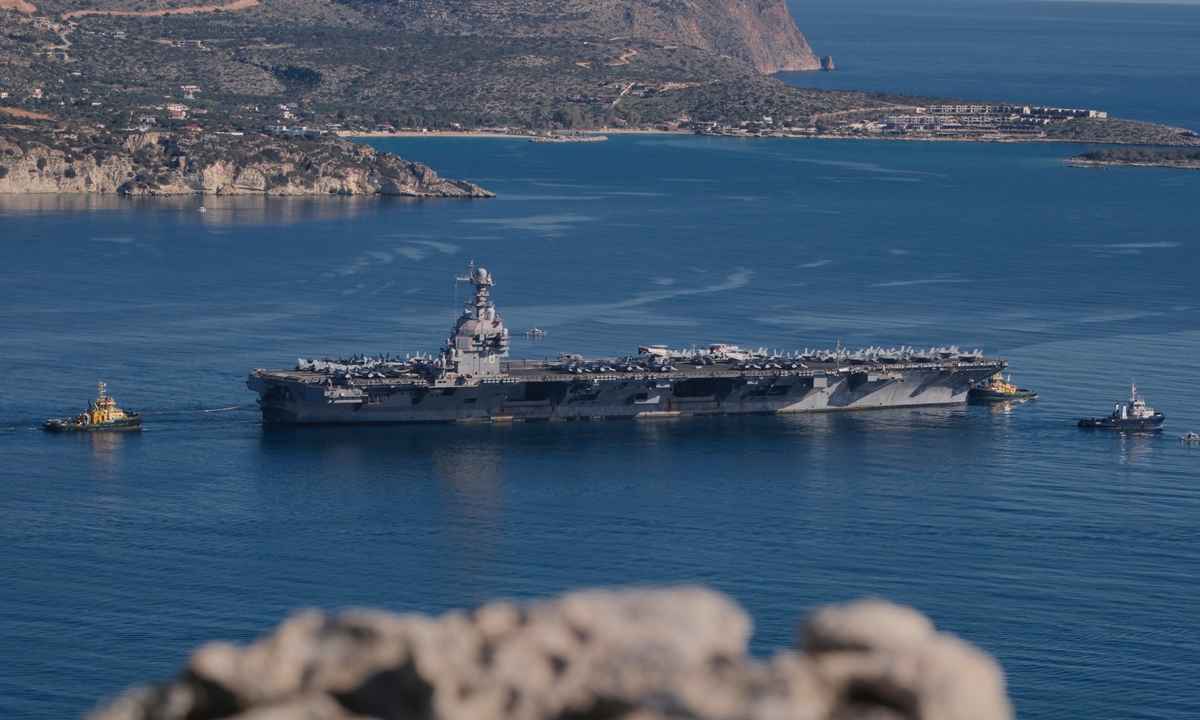
The USS Gerald R. Ford departs from Souda Naval Base near Chania on the island of Crete, Greece, on February 26, 2026. Photo: VCGUS President Donald Trump's reported push to reshape the US Navy's next-generation aircraft carriers - from moving the island to abandoning electromagnetic catapults in favor of steam-powered systems - could impose heavy engineering, financial and schedule costs, Chinese military affairs experts said, warning of a widening gap between political preferences and the realities of building some of the world's most complex warships.
The Washington Post reported on Saturday that the US Navy is considering a major redesign of its new Ford-class aircraft carriers to better match Trump's preferred aesthetic, with the president favoring ships that more closely resemble US carriers from the World War II era. One option under study would move the carrier's island farther forward, toward the middle of the ship.
US officials cited by the report warned that such a change could require billions of dollars in redesign costs and cause substantial delays.
The potential island redesign comes only days after Trump ordered another far-reaching change to the Ford-class program. On Thursday, he signed a national security memorandum directing the Pentagon and Navy to develop a plan within 60 days to replace the Electromagnetic Aircraft Launch System (EMALS) with steam catapults and the Ford-class carriers' Advanced Weapons Elevators with hydraulic systems, beginning with the future
USS Doris Miller, or CVN-81, USNI News reported.
Trump has repeatedly criticized EMALS as "too complex" and "not as effective as steam catapults," according to Reuters.
But the order would reverse a technology path the US Navy has pursued for more than a decade. When the Navy selected EMALS in 2009, it said the system would lower overall lifecycle costs, require less maintenance than steam catapults and place less physical stress on carrier-based aircraft, per Reuters.
As of March 2026, the
USS Gerald R. Ford had conducted 36,863 EMALS launches, according to Pentagon documents cited by Reuters.
General Atomics, the manufacturer of EMALS, has warned against changing course on the
Doris Miller, saying nearly 50 percent of production related to the system has already been completed and that a switch now would create significant cost, schedule and integration risks, according to Reuters.
Zhang Junshe, a Chinese military affairs expert, told the Global Times on Sunday that the Ford-class carrier's aft-positioned island is not merely an aesthetic choice, but is closely tied to flight-deck efficiency and landing safety. "Moving the island farther aft creates more space around the catapults for aircraft parking and handling, helping shorten launch preparation time, while also reducing airflow disturbance during aircraft recovery," he said.
Relocating the island forward would not be a simple cosmetic adjustment, but a major redesign affecting weight distribution, buoyancy, flight-deck layout and aerodynamics, with significant implications for both cost and schedule, Zhang noted.
Song Zhongping, another Chinese military affairs expert, told the Global Times that Trump's demand is one thing, but turning it into an actual warship design is another.
"The first four Ford-class carriers have either entered service or are already in different stages of construction, leaving very little room for fundamental changes to their overall designs," Song said. Even the fifth and sixth ships - the future
USS William J. Clinton, CVN-82, and
USS George W. Bush, CVN-83 - would face considerable cost and engineering consequences if the Navy attempts to overturn their established technological architecture, he said.
The US Navy officially announced the names of CVN-82 and CVN-83 in January 2025, per the US Navy official website.
"There is an obvious gap between US President's political will and the engineering realities of aircraft-carrier construction," Song said.
Such proposed changes come as Ford-class construction timelines have already grown considerably compared with those of the preceding Nimitz class. The US Congressional Budget Office (CBO) said in April that Nimitz-class carriers typically took seven to eight years to build, while Ford-class ships are currently taking roughly 10 to 11 years. In a separate assessment released this month, the CBO estimated that future Ford-class carriers under the Navy's 2027 shipbuilding plan could cost about $22 billion apiece.
"Electromagnetic launch represents an advanced direction in aircraft-carrier catapult technology and has far greater development potential than traditional steam catapults," Song said. "If the US gives up electromagnetic catapults and returns to steam catapults, that would be a technological regression and a step backward."
Echoing Song, Zhang said electromagnetic catapults offer more precise control of launch energy and broader compatibility with different types of carrier-based aircraft, while requiring less shipboard space than steam systems with their extensive high-pressure piping.
"Replacing EMALS with steam catapults on a Ford-class carrier already designed around electromagnetic launch would not only represent a technological step backward, but could also turn an attempt to reduce risk into a new source of engineering and system-integration risk," Zhang said.
。

B | 8月24日消息,据新华社报道,截至本月24日,日本东京电力公司福岛第一核电站核污染水排放满三年,迄今共进行了22轮核污染水排放,累计排放量约17.3万吨。
按照东电公开数据,截至本月13日,福岛第一核电站厂区储罐内依旧留存核污染水约123.5万吨,储罐存量对比排海启动之初仅下降约8%。 出现这种情况的核心原因是,核电站地下持续渗入雨水与地下水,源源不断生成新的核污染水,一边向外排海,一边不断产生新废水,导致储罐水位下降速度远慢于实际排海规模。 东京电力公司的报废计划显示,核污染水排海工作将一直持续到2051年反应堆报废完成,整个排海周期长达二十余年。 每一轮排海排放量基本维持在7800吨左右,第22轮排海于8月17日结束,共计排放7888吨核污染水,内含氚约1.3万亿贝克勒尔。
三年来,日本国内渔业群体的反对立场始终没有改变,日本全国渔业协会联合会多次公开表态,在没有获得渔业从业者充分理解的前提下,核污染水排海行为不能被接受。

C | 受核污染水排海影响,水产品相关索赔不断增加,截至今年8月初,东电已经针对约1100件渔业相关索赔,支付赔偿金合计928亿日元。
【本文结束】如需转载请务必注明出处:
责任编辑:落木
文章内容举报
。
Current article:http://my16zr.chuanshaonianmokuanchouzhei.sbs/news/20260826_7374007.html
Published on:10:37:15
 微信
微信 移动端
移动端